
Are water oaks and laurel oaks a storm risk? Yes, more than most trees in Wilmington yards. NC State Extension says water oak limbs "are notoriously weak and at risk for breakage particularly in high winds or during winter snow and ice storms" (NC State plant profile), and a University of Florida study found laurel oak survived hurricanes significantly worse than live oak (Arboriculture & Urban Forestry). NC State's Pender County Center lists both among the trees to avoid near structures (NC State Extension). That does not mean every one must come down, but older trees near a house deserve a regular look.
Wilmington NC Tree Removal is a free quote service. We connect Wilmington-area homeowners with independent local tree companies for free, no-obligation quotes. The company you choose quotes, contracts and does the work directly with you.
Why these two oaks matter in Wilmington
Laurel oak is one of the most common trees in the city. A 2023 urban forestry master plan put it at about 14% of Wilmington's roughly 32,500 public trees, compared with about 8% for live oak (Port City Daily). Plenty of private yards have them too, many big enough to reach a roof.
Age is part of the problem. The University of Florida notes that a 30–50 year lifespan is common for water oak (UF/IFAS). An older water oak may be nearing the end of its typical life.
How water oaks and laurel oaks fail
- Limb breakage. Weak limbs are the main water oak problem in NC State's profile. Large lateral limbs over roofs, driveways and decks are the ones to watch.
- Decline from the top down. Oak decline is a slow process: heat or drought stress first, then disease and borers. Dieback starts at the branch tips (NC State Extension, oak decline). Thinning crowns and dead twigs at the top are an early warning.
- Whole-tree failure in wet soil. Many Wilmington soils hold water close to the surface. USDA-NRCS describes Leon soils with a water table at 6–18 inches for one to four months most years (Leon series). Pender Extension advises against large trees where the water table is within 18 inches, because roots stay shallow and windthrow risk rises.
What storms have shown here
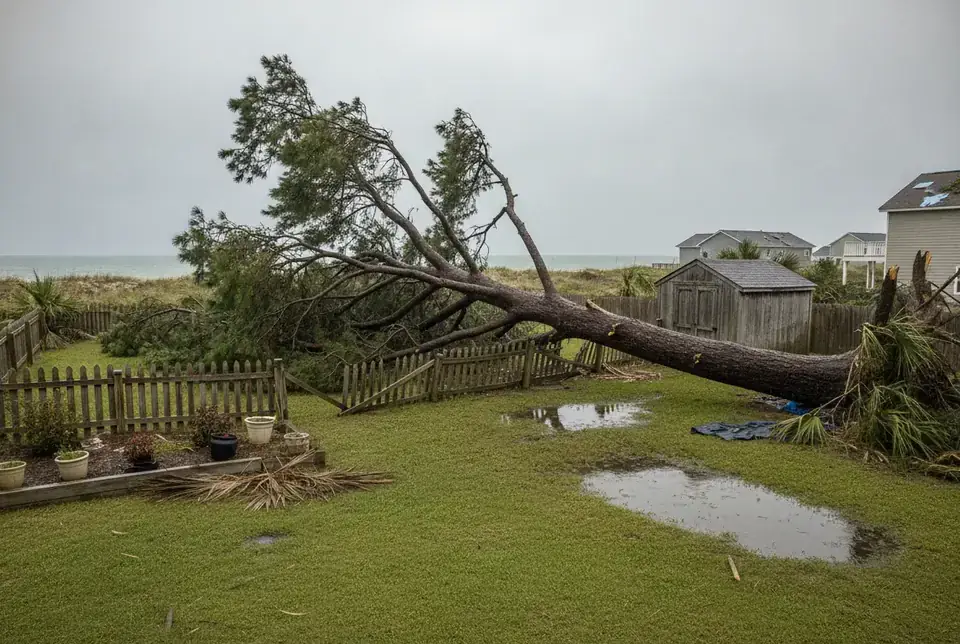
Wilmington's storm record shows what wind and saturated soil do to weak trees. During Florence in 2018, the airport recorded 23.02 inches of rain and a 105 mph gust, "many trees and power lines" came down across New Hanover County, and crews collected over 1.2 million cubic yards of debris (NWS Wilmington). Matthew's 2016 damage was "primarily to trees and power lines" (NWS), and Fran in 1996 brought an 86 mph gust at the airport (NWS).
Wind is not the only threat. The February 11–12, 2014 ice storm left 0.56 inches of ice at Wilmington International Airport (NWS), and NC State specifically calls out ice and snow as a breakage risk for water oak limbs.
What about oak wilt?
You may read that oaks should only be pruned at certain times to avoid oak wilt, and NC State does note water oak's susceptibility. In North Carolina, though, confirmed oak wilt records are from the mountains, mostly near the Tennessee line (USDA Forest Service, 2010). It is not the main concern for Wilmington oaks; weak limbs, decline and storm loading are.
Warning signs worth a closer look
- Dead branches or bare tips high in the crown.
- Large limbs with cracks, cavities or fungal growth where they join the trunk.
- Mushrooms or conks at the base, or soft, crumbly wood at the root flare.
- A new lean, or soil heaving on one side after a storm.
- Limbs that hang over the roof, a bedroom or a parking spot.
If you see any of these, an arborist assessment is a sensible first step. Published cost guides put an arborist assessment or tree inspection at about $198 on average in Wilmington (LawnStarter Wilmington) — typical ranges from published cost guides (2025–2026) — estimates, not quotes.
Your options: prune, cable or remove
Pruning. Removing dead wood and reducing heavy limbs over the house can lower risk on a tree that is otherwise sound. Avoid topping; Pender Extension notes that severe pruning increases decay and failure risk.
Cabling or bracing. Cables can support a weak fork on a tree worth keeping. Cost guides list cabling or bracing at about $382 on average in Wilmington — an estimate, not a quote.
Removal. For a declining oak over a home, tree removal may be the safer long-term answer. Published guides put removal at about $695 on average in Wilmington, with a 60 ft tree around $680–$1,290; see the tree removal cost guide for more. If a storm has already brought one down, see emergency and storm tree removal; costs run higher than a planned removal, so get written quotes.
Planned removal before storm season is usually calmer and cheaper than cleanup after one. Our hurricane tree prep guide covers timing. If you replant, live oak and other species in our wind-resistant trees guide are sturdier choices.
Before you remove a large oak
Permits can apply depending on where you live, lot size and whether the tree is in the right-of-way or a historic district, so read the Wilmington tree removal permit guide first. In unincorporated New Hanover County, the county adopted protections for large live oaks in 2019; confirm current rules with the county. Many HOAs require architectural approval before tree removal — check your covenants. This is general information, not legal advice.
If a tree is touching or near a power line, stay away and call your electric utility (Duke Energy, or your co-op) — only utility-qualified crews should work near energized lines.
If a company will spray or inject an oak for pests or disease, it needs an NC commercial pesticide applicator license (Core plus Ornamental & Turf) (NC State Extension). When comparing quotes, ask for:
- A certificate of general liability insurance and workers' compensation coverage.
- Whether an ISA Certified Arborist is on staff (a private credential from the International Society of Arboriculture, not a state license; verify at treesaregood.org).
- Whether the company is TCIA Accredited (a private Tree Care Industry Association program).
- An NC commercial pesticide applicator license (Ornamental & Turf category) if they will spray or inject.
- A written quote that states cleanup, haul-away, stump grinding depth and whether a permit is included.
Frequently asked questions
Are water oaks dangerous in a storm?
Water oaks are more prone to storm damage than many trees. NC State Extension calls their limbs notoriously weak and at risk of breaking in high winds and during ice or snow storms. Risk depends on the individual tree: its age, health, lean and what sits beneath it. An arborist assessment can tell you whether pruning, cabling or removal makes sense.
How long do water oaks live?
The University of Florida notes that a lifespan of 30 to 50 years is common for water oak. Many water oaks in older Wilmington neighborhoods were planted decades ago, so some are at or past that range. Signs of decline include dieback at branch tips, dead limbs high in the crown and decay at the base.
What is the difference between a laurel oak and a live oak in a hurricane?
In a University of Florida study published by the International Society of Arboriculture, laurel oak survived hurricanes significantly worse than live oak. NC State Extension lists live oak among the most wind-resistant large trees and laurel oak among the trees to avoid near structures. Both are common in Wilmington, so knowing which you have is useful.
Get a free quote for an oak you're worried about
Whether you need dead wood pruned, a fork cabled or a declining oak taken down, a free, no-obligation quote request takes about a minute. We usually reply the same day and connect you with independent local tree companies; you decide whether to move forward.